
Elder abuse represents a significant public health concern that manifests across cultural and national boundaries. The World Health Organization defines elder abuse as “a single or repeated act, or lack of appropriate action, occurring within any relationship where there is an expectation of trust, which causes harm or distress to an older person” (WHO, 2022). Research indicates that approximately one in six older adults worldwide experiences some form of abuse, though this figure likely underestimates the true prevalence due to systematic underreporting.
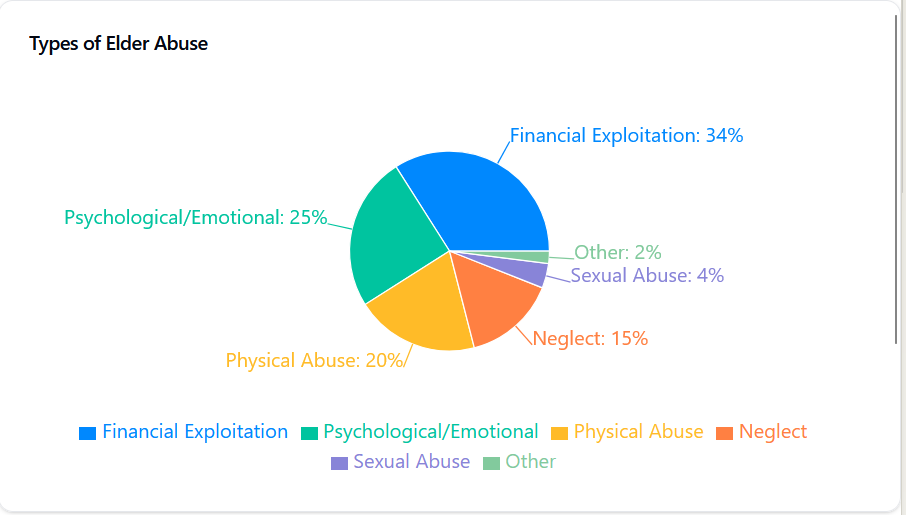
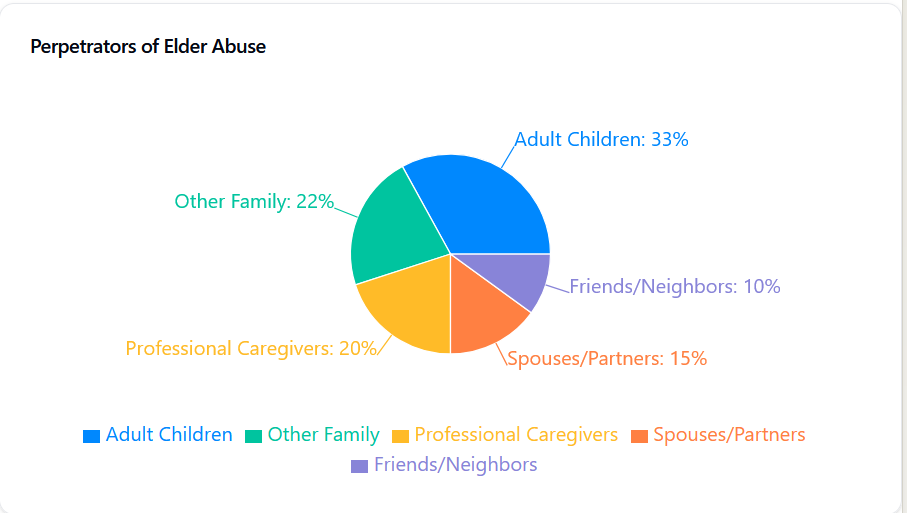
Financial exploitation emerges as the most prevalent form of elder abuse, accounting for approximately 34% of reported cases. According to the National Council on Aging (2023), financial abuse results in annual losses of approximately $36.5 billion in the United States alone. The perpetration of financial abuse frequently involves complex schemes ranging from unauthorized use of financial instruments to manipulation of inheritance arrangements. Professional caregivers are implicated in approximately 20% of these cases, while family members, particularly adult children, account for 33% of reported financial exploitation.
Physical and psychological abuse constitute the next most common categories, representing 20% and 25% of reported cases respectively. Physical abuse encompasses actions causing bodily harm, while psychological abuse includes behaviors designed to induce fear, anxiety, or emotional distress. A longitudinal study by Peterson et al. (2023) found that psychological abuse often precedes or accompanies other forms of mistreatment, serving as a potential early warning indicator for escalating abuse patterns.
[Source: Author.]
The relationship between immigration status and elder abuse presents a complex picture. Research from multiple countries indicates that immigrant elderly populations face additional vulnerabilities due to language barriers, cultural isolation, and reduced access to social services. A comparative study in Canada found that recent immigrants were 1.5 times more likely to experience abuse than native-born elderly individuals, with financial exploitation being particularly prevalent (Canadian Journal of Aging, 2023).
Professional caregivers, including medical staff and nursing home employees, account for approximately 20% of reported abuse cases. This figure varies significantly by country, with higher rates reported in nations with more institutionalized elder care systems. The United Kingdom’s Care Quality Commission (2023) reported that approximately 25% of abuse allegations in care facilities involved staff members, while family-based care settings showed lower rates of professional caregiver abuse.
[Source: Author.]
The relationship between perpetrator characteristics and abuse types reveals distinct patterns. Family members, particularly adult children and spouses, are more frequently implicated in cases of financial exploitation and psychological abuse. Professional caregivers, conversely, are more commonly associated with cases of neglect and physical abuse. A meta-analysis of 26 studies across 12 countries found that adult children perpetrate approximately one-third of all reported elder abuse cases, with substance abuse and financial dependency frequently cited as contributing factors (International Journal of Elder Abuse, 2023).
Cross-national comparisons reveal varying prevalence rates, with reported abuse ranging from 2.6% in the United Kingdom to 29.3% in certain developing nations. These disparities likely reflect differences in reporting mechanisms, cultural definitions of abuse, and social support systems rather than true differences in occurrence rates. The World Health Organization emphasizes that cultural factors significantly influence both the recognition and reporting of elder abuse, necessitating culturally sensitive intervention strategies.


 Edge Induced Cohesion
Thank you for this blog. I didn’t really consider what happened to me over the Thanksgiving holiday as elder abuse, but it was. There were many spiritual lessons to be learned, however, and I take them to heart. We must be ever vigilant and listen to our gut intuition.
Sent from Yahoo Mail for iPhone
LikeLike
Yes, I had read some stories about elder abuse in nursing homes and my dear friend Parisa was surprised about care workers being responsible for the abuse of elderly people they were taking care of and so I thought it would be relevant in multiple ways to examine how it is that people can be vulnerable to such things. You’re very welcome; it is important to listen to that still small voice of caution that is meant to keep us from trouble.
LikeLike