
The structure and size of national cabinets reflects both administrative needs and political priorities across different societies and time periods. Historical analysis reveals a general trend toward larger cabinets throughout the 20th and early 21st centuries, with most developed nations now maintaining between 15 and 25 cabinet-level positions. This expansion correlates strongly with increasing governmental responsibilities and specialization of administrative functions.
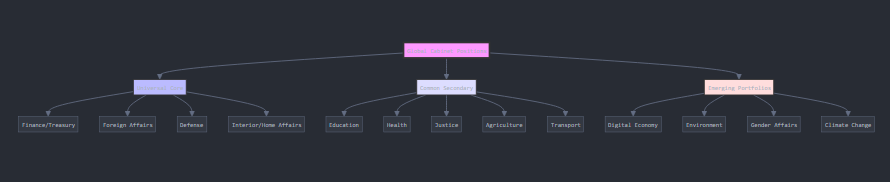
Core ministries that emerged during the initial development of modern state structures typically included finance, foreign affairs, interior/home affairs, and defense. These departments, which political scientist Martin Lodge refers to as the “cardinal portfolios,” remain nearly universal across all systems of government. In his 2005 study “The Evolution of Modern Governance,” Lodge notes that these positions represent the fundamental responsibilities of the nation-state: economic management, diplomatic relations, domestic security, and national defense.
Regional variations in cabinet structures often reflect different developmental priorities and cultural emphases. For instance, Middle Eastern nations frequently maintain dedicated ministries for religious affairs, while Pacific Island nations commonly have cabinet-level positions focused on maritime resources and climate change adaptation. The prominence of certain portfolios can serve as an indicator of national priorities and challenges.
Developing nations have shown interesting patterns in their cabinet evolution. Many post-colonial states initially adopted administrative structures similar to their former colonial powers but have since modified these to address local needs. For example, numerous African nations have established ministries dedicated to national cohesion or inter-ethnic relations, reflecting the importance of managing diverse populations within post-colonial boundaries.
The late 20th century saw the emergence of new portfolio categories across most nations. Environmental protection, digital transformation, and gender equality have gained ministerial status in many countries, indicating shifting societal priorities. These newer additions often face challenges in establishing their authority and securing resources compared to traditional ministries.
Economic development status appears to correlate with certain patterns in cabinet structure. Developed nations tend to have more specialized economic portfolios (separate ministers for trade, industry, labor, etc.), while developing nations often combine these functions under broader economic affairs ministries. However, this pattern shows significant variation based on country size and governance model.
[Source: Author]
Recent trends indicate a potential plateau in cabinet size among developed nations, with some countries experimenting with portfolio consolidation to improve coordination and reduce administrative overhead. The United Kingdom’s creation of the Department for Levelling Up, Housing and Communities in 2021 exemplifies this trend toward strategic portfolio combination.
Population size shows surprisingly little correlation with cabinet size. Small nations like Singapore (with approximately 5.6 million people) maintain cabinet structures similar in size to much larger countries, suggesting that basic governmental functions require a minimum number of portfolios regardless of population.
The study of cabinet structures reveals much about how nations perceive and organize their governmental responsibilities [1]. While core functions remain remarkably consistent across cultures and development levels, the variation in specialized portfolios provides insight into different approaches to governance and national priorities. Future research might productively explore how emerging challenges like artificial intelligence and climate change continue to reshape cabinet structures worldwide.
[1] Consider, for example, the case of tourism:
Small island nations and archipelagic states demonstrate the highest prevalence of cabinet-level tourism positions. This pattern emerges particularly strongly in the Caribbean, where nations like Jamaica, the Bahamas, and Barbados maintain dedicated Ministries of Tourism. These appointments reflect the outsized role that tourism plays in their economies, often contributing more than 30% to their GDP.
Mediterranean nations similarly prioritize tourism at the cabinet level, though with some variation in how the portfolio is structured. Greece, for instance, maintains a Ministry of Tourism and Sports, while Croatia has a standalone Ministry of Tourism. This regional pattern extends across both European and North African Mediterranean coastlines, highlighting how geographic and climatic advantages influence governmental organization.
Developing nations with significant tourism potential often elevate tourism to cabinet level as part of their economic development strategy. Countries like Thailand, Vietnam, and Indonesia in Southeast Asia maintain prominent tourism ministries, integrating them closely with economic development and cultural preservation portfolios. This approach reflects what tourism scholar Richard Butler terms the “developmental tourism paradigm” – using tourism as a catalyst for broader economic growth.
Interestingly, many highly developed nations with substantial tourism sectors, such as France, Italy, and the United States, tend not to have standalone tourism ministries. Instead, they typically incorporate tourism responsibilities within broader economic or cultural affairs portfolios. This might reflect their more diversified economies and the maturity of their tourism sectors, which require less direct governmental intervention.
A fascinating temporal pattern emerges when examining the historical development of tourism portfolios. The creation of dedicated tourism ministries often coincides with periods of economic transition or post-colonial development. For example, many African nations established tourism ministries in the 1960s and 1970s as part of their post-independence economic diversification strategies.
Regional economic blocs also influence tourism portfolio structures. Within the European Union, tourism policy coordination occurs primarily at the supranational level, potentially reducing the need for dedicated national ministries. Conversely, in ASEAN, where tourism is seen as a key driver of regional integration, member states frequently maintain high-level tourism portfolios.
The COVID-19 pandemic has influenced this landscape, with some nations either elevating or creating new tourism portfolios in response to the sector’s vulnerability. This trend has been particularly notable in countries like the Maldives and Fiji, where the pandemic’s impact on tourism highlighted the need for cabinet-level representation of the sector.


 Edge Induced Cohesion