
Keep Up Your Biblical Aramaic In Two Minutes A Day: 365 Selections For Easy Review, by Jonathan G. Kline
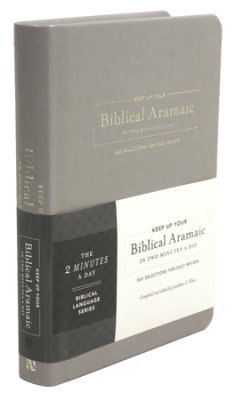
[Note: This book was provided free of charge by Hendrickson Publishers. All thoughts and opinions are my own.]
While I do not consider myself to be a scholar of the ancient languages of the Bible, as someone who has an interest in biblical Aramaic [1], this book is definitely of interest to me. It should be noted that this book is not considered as a substitute for the study of the grammar and syntax of the Aramaic language, but is designed to provide the entire corpus of biblical writing in that language for the reader to study and read. Those who are able to devote a great deal of time to their study of this language can be expected to greatly improve their understanding of biblical Aramaic while those who have only a little bit of time to read the book over the course of a year still can gain some from keeping the subject matter in mind, as it is hard to keep up a language that one learns as an adult without periodic refreshing, which this book does very well.
This book can be considered as a devotional that is supercharged to give understanding to the Aramaic text that occurs mostly in Daniel and Ezra in the Bible (as well as one verse in Jeremiah and part of a verse in Genesis). Each day of a normal 365-day year is given a verse that has two (or more) words to study/refresh present. The structure of the book is consistent throughout, with introductory material on top in the header, the verse of interest itself immediately below this, two words (usually) given in the square form along with its transliteration, the meaning in English, and the frequency the word appears in the Bible. The biblical text then appears from the Hebrew Bible appears below followed by a discussion of the verse on a phrase by phrase basis with the word(s) of the day highlighted within the text. Those words which appear more commonly come first and then the book ends with those verses that contain words only used once. Throughout the book shows a consistently high standard of biblical scholarship and the author is intent on encouraging readers to look at the cited verses in context in order to better understand them, even though they are in isolation within the book itself.
Although this book is clearly aimed at a scholarly audience which is at least familiar with Aramaic and which knows the conventions of biblical writing in the Hebrew scriptures (including the use of prefixes and suffixes, reading from right to left within lines, the fact that some letters have a different form if they are the last letter of a word, and so on), for those who are able to read and understand this book there is a great deal of insight that one can gain into the biblical Aramaic of the Hebrew scriptures, including the fact that some words’ meanings are not exactly known, which has led the author to note these translations with a question mark afterward. Most surprisingly in this case is the language about the clothing in Daniel 3:21 or several terms in Daniel 6:19, and the fact that the author is willing to admit ignorance of the precise meaning even if the sense of it is clear enough is itself something that is worth appreciating and respecting. A book that shows conspicuous signs of knowledge but also an awareness of the limits of that knowledge is certainly something to view with a great deal of respect.
[1] See, for example:
A Modest Proposal For The Creation Of A Bible Reading Program Study Bible
Book Review: Early Manuscripts & Modern Translations Of The New Testament


 Edge Induced Cohesion
Reblogged this on James' Ramblings.
LikeLike
I reviewed the two volumes from the same author/publisher on keeping up one’s biblical Hebrew a few days ago :D.
LikeLiked by 1 person
Pingback: Book Review: Everyman’s Bible Commentary: Daniel | Edge Induced Cohesion
Pingback: Book Review: Daily Encouragement For The Smart Stepfamily | Edge Induced Cohesion
Pingback: Book Review: A Proverb A Day In Biblical Hebrew | Edge Induced Cohesion
Pingback: Book Review: Prevail | Edge Induced Cohesion