
Sticking Points: How To Get 4 Generations Working Together In The 12 Places They Come Apart, by Haydn Shaw
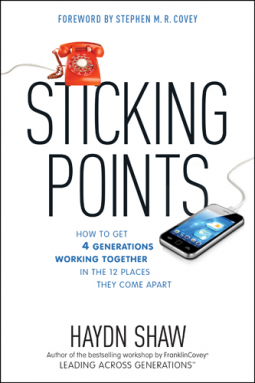
[Note: This book has been provided gratis by Tyndale Publishers in exchange for an honest review.]
As a student of generations and their different lives and perspectives (I once wrote a somewhat lengthy paper on the subject for my own religious tradition as a way of understanding and legitimizing my own differences vis-a-vis the other generations of my own religious culture who are not particularly understanding or tolerant of my own generational perspective or the experiences that have driven it), this is a book I was particularly looking forward to read, and despite some minor copyediting concerns (occasional omitted words or punctuation or spelling errors), this is a book that is a pleasure to read except that it tended to make me a bit amped up in the way the author expressed serious concerns that have long plagued me as a cusper between Generation X and the Millennials, combining some aspects of both generations (the cynicism and difficult life experiences of Generation X with the sociable and friendly and feedback-loving nature of Millennials).
As a book that seeks to distill a large amount of disparate research on various generations (those born before 1943 are termed “Traditionalists,” those born between 1943 and about 1960 are called “Baby Boomers,” those born between 1961 and 1981 are considered “Generation X” and those born between 1982 and about 2002 or so are considered “Millennials”) into a single volume of slightly more than 200 pages, this book admittedly (and openly) deals with generalities and does not have the same precise nuance that a larger book would have. Nevertheless, despite this, it does serve a valuable part as a book that seeks to education managers and executives into the need to wisely handle the legitimate concerns and well-being of members of all the generations that are currently in the workplace. This is a task of some seriousness, a task many organizations have very little understanding about, and a task that will only increase in importance as an aging population makes advancement and providing for the needs of our society more difficult.
One particularly praiseworthy aspect of this book is the way in which it begins by telling “ghost stories” of all of the generations to describe the key events and cultural phenomena that shaped them. Speaking for myself, what puts me as a Generation Xer for the most part instead of a Millennial is the rather savage nature of my own upbringing and childhood, which bred a certain cynical realism about life that more pampered and privileged Millennials have been fortunate enough to avoid through being treated with much more care and respect during their youth. After these ghost stories are given, the book gives twelve “sticking points,” or areas of friction and tension between generations (communication, decision-making, dress code, feedback, fun at work, knowledge transfer, loyalty, meetings, policies, respect, training, and work ethic), giving a five-step pattern for resolving these difficulties (acknowledge, appreciate, flex, leverage, and resolve). This organization helps to make what is probably unfamiliar material for many readers much more easy to grasp, especially concerning the need for older generations in leadership positions to make difficult and necessary changes to better allow their organizations to capture the strengths that often-neglected and often-insulted younger generations can provide to those who know how to work effectively and respect younger people.
Another strength of this work is the fact that the author (himself a cusper between Baby Boomers and Generation X) has real-life experience and a great deal of personal research and consulting to draw upon for examples. Many of the examples talked about ring true, whether it is the nearly universal Millennial tendency to text on smart phones at every possible opportunity (or to enjoy wearing flip-flops nearly all the time), for Gen Xers or Millennials to enjoy personal internet (particularly social media) and e-mail use at times that others may view inappropriate for work, or for the tendency of Baby Boomers and Traditionalists to drone on in endless personal stories that are not often of interest to younger generations. These sorts of practical examples of the insights the author presents help make it readily relevant while not increasing its length to the point where it would be unmanageable for those looking for immediate and actionable information to help out their organizations. With a bit more copyediting to fix the errors due to its presumably rapid writing, this book will be a must-read for any organization that wishes to resolve its inter-generational tensions, which is to say that this book should find a wide and appreciative business (and not-for-profit) audience. It should be noted that this book is generally written from a North American perspective, though it does include some examples from Panama and India as well as Europe.


 Edge Induced Cohesion
Pingback: Book Review: 48 Days To The Work You Love | Edge Induced Cohesion
Pingback: Book Review: Abandoned Faith | Edge Induced Cohesion