
The development of college football’s championship selection process reflects the sport’s continuous effort to establish a more equitable and comprehensive method for determining its national champion. The Bowl Championship Series (BCS), implemented in 1998, marked the first systematic attempt to pair the top two teams in a championship game using a combination of human polls and computer rankings. This system, while groundbreaking, faced persistent criticism for its perceived biases and limitations in team selection.
The BCS era (1998-2013) demonstrated a clear dominance by Southeastern Conference (SEC) programs, particularly Alabama under Nick Saban’s leadership. The selection criteria during this period heavily weighted strength of schedule, overall record, and conference championship results. Notable controversies emerged, such as the 2003 split national championship between LSU and USC, highlighting the system’s limitations in achieving consensus on the most deserving teams.
The transition to the College Football Playoff (CFP) in 2014 expanded access to the championship determination process by including four teams selected by a committee of athletic directors, former coaches, and other football experts. The selection committee emphasizes several key factors in their decision-making process: strength of schedule [1], conference championships, head-to-head competition, and comparative outcomes against common opponents. This system has maintained the SEC’s prominent position while providing more opportunities for programs from other Power Five conferences.
Recent developments have led to the approval of a 12-team playoff format, scheduled to begin in the 2024 season. This expansion represents the most significant change in college football’s championship structure, incorporating automatic qualifiers for conference champions while maintaining at-large spots for deserving teams. The new format aims to address long-standing concerns about access for Group of Five conferences and independent programs.
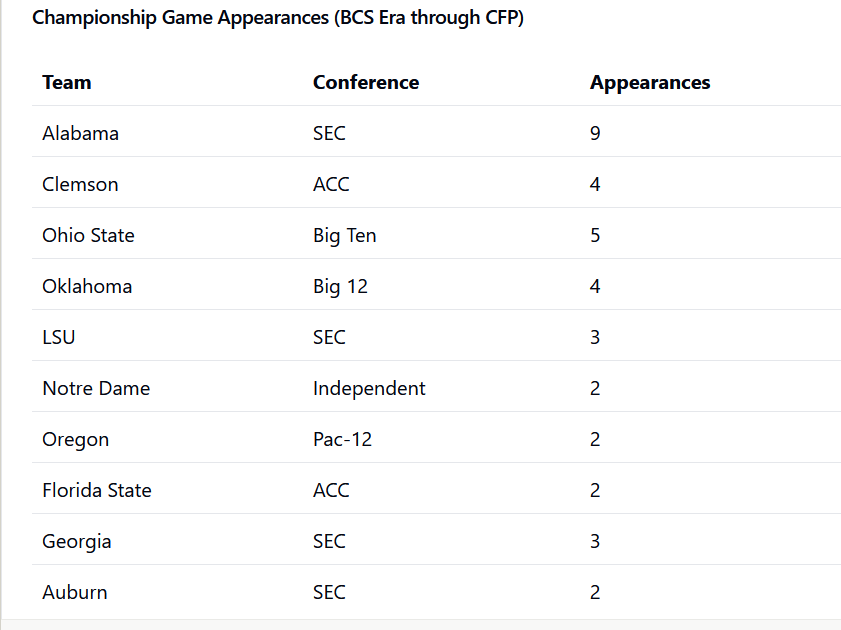
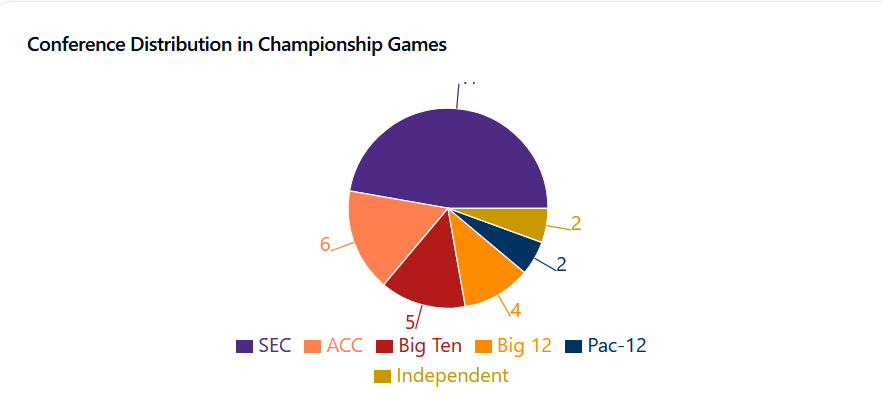
Analysis of championship participation data reveals significant disparities in conference representation. The SEC has dominated with 17 total appearances across the BCS and CFP eras, followed by the ACC with 6 appearances and the Big Ten with 5 appearances. Individual program success has been similarly concentrated, with Alabama making 9 appearances, Ohio State 5, and Clemson 4 since 1998.
[Source: Author]
The data presented in the visualizations demonstrates the persistent regional power dynamics in college football, with programs from the southeastern United States maintaining particular prominence in championship contention. This concentration of success has influenced ongoing discussions about competitive balance and access to championship opportunities in college football’s highest division.
Looking ahead, the 12-team playoff format may alter these historical patterns by providing guaranteed access for conference champions while maintaining opportunities for at-large selection of particularly deserving teams. This evolution in the selection process reflects college football’s ongoing attempt to balance tradition with the need for broader competitive opportunity.
[1] Concerning strength of schedule:
The comparison of strength of schedule across college football programs presents several methodological challenges that warrant careful examination. These difficulties become particularly pronounced when analyzing the relative competitive quality of different conferences and their constituent programs.
Consider first the circular nature of strength of schedule calculations within conferences. When teams from the SEC or Big Ten play predominantly against conference opponents, their strength of schedule metrics become partially self-reinforcing. For example, Alabama’s schedule strength benefits from playing Georgia, while Georgia’s benefits from playing Alabama. This creates what statisticians term an endogeneity problem – the variables being measured are influencing each other in ways that make isolation of true competitive strength difficult.
Out-of-conference scheduling patterns reveal interesting disparities in how programs approach non-conference competition. An analysis of the past decade’s scheduling shows that Power Five programs average approximately three non-conference games per season. However, the timing and quality of these matchups vary significantly. Many SEC and ACC programs traditionally schedule their primary non-conference rivalry games (like Florida-Florida State or Georgia-Georgia Tech) in the final week of the regular season. In contrast, Big Ten and Pac-12 programs often front-load their challenging non-conference games in September.
The financial incentives of modern college football further complicate schedule strength comparisons. Programs from resource-rich conferences can offer substantial financial guarantees to secure home games against lower-division opponents, leading to what are effectively predetermined victories. This practice, while financially beneficial, creates statistical noise in strength of schedule calculations. For instance, an SEC team might play eight conference games against traditionally strong opponents but pad their remaining schedule with FCS and lower-tier Group of Five programs.
When isolating only out-of-conference games against Power Five opposition, interesting patterns emerge. Over the past decade, the Big Ten and Pac-12 have consistently scheduled the highest percentage of non-conference games against other Power Five programs, averaging around 1.8 such games per team per season. The SEC and ACC, despite their strong in-conference schedules, have averaged closer to 1.3 such games per team. This disparity suggests that conference strength may be somewhat overstated when relying solely on overall schedule strength metrics.
The advent of conference championship games adds another layer of complexity to schedule comparison. Teams that reach their conference championship game effectively play an additional high-quality opponent, potentially skewing their strength of schedule metrics relative to teams that miss their conference championship. This creates a scenario where success can compound schedule strength in ways that may not accurately reflect the true difficulty of a team’s regular season schedule.
Recent developments in analytics have attempted to address these challenges through more sophisticated methodologies. The ESPN Football Power Index (FPI) and similar metrics now attempt to control for conference effects by incorporating factors like recruiting rankings, coaching stability, and historical program success. However, these methods still struggle with the fundamental challenge of comparing teams that rarely play common opponents outside their conferences.
The expansion to a 12-team playoff format may inadvertently exacerbate these comparison difficulties. With automatic bids for conference champions, programs may have even less incentive to schedule challenging non-conference games, potentially leading to further divergence in out-of-conference scheduling patterns across different conferences.


 Edge Induced Cohesion